


As Past Chair of the Board of Directors for Jewish Family Services of Milwaukee, a Trustee of the Jewish Community Foundation, a Board Member of the Milwaukee Jewish Federation, and Past Chair of Operation DREAM, I've spent considerable time in the nonprofit world—not as legal counsel, but as a volunteer leader responsible for guiding organizations through complex challenges with limited resources and high stakes.
What surprised me most wasn't how different nonprofit leadership is from business leadership. It was how remarkably similar the challenges are—and how the lessons I've learned in boardrooms focused on community impact have made me a better business attorney.
The Challenge: When Mission Meets Reality
A few years ago, while serving on a nonprofit board, we faced a scenario that many growing organizations encounter: our programs were succeeding beyond our capacity to deliver them sustainably. Demand was increasing, our staff was stretched thin, and we had to make difficult decisions about which initiatives to expand, which to pause, and how to communicate those choices to stakeholders who were passionate about different aspects of our mission.
Sound familiar? It should. I've seen this exact pattern play out with manufacturing clients experiencing rapid growth, medical practices expanding into new locations, and businesses that suddenly find their successful product line straining their operational infrastructure.
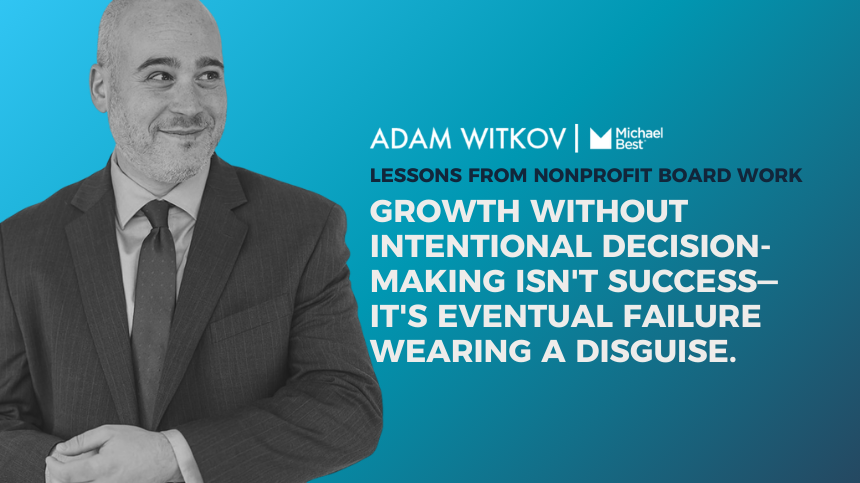
The nonprofit context forced us to confront a truth that businesses often avoid until crisis hits: growth without intentional decision-making isn't success—it's eventual failure wearing a disguise.
The Business Parallel: Strategic Constraint as Competitive Advantage
In business, we often frame resource constraints as problems to solve through capital infusion. Get more funding, hire more people, expand capacity. But nonprofit board work taught me that constraints, when properly understood, actually force the kind of strategic clarity that many businesses desperately need.
When a nonprofit has to decide between two worthy programs with insufficient resources for both, the conversation becomes brutally honest about mission alignment, measurable impact, and stakeholder priorities. There's no room for the kind of ambiguity that businesses sometimes tolerate—continuing initiatives that aren't working because "we've always done it that way" or avoiding hard choices because "we'll figure it out next quarter."
I've watched my manufacturing clients face similar crossroads: Should they invest in automating an existing production line or develop a new product line? Should they expand their workforce or invest in retention and training for existing employees? The framework for answering these questions is identical whether you're running a nonprofit or a $50 million manufacturing company.
What Worked: Three Principles That Translate Directly to Business
1. Stakeholder Alignment Before Strategy
In nonprofit board governance, you can't make significant strategic decisions without first understanding what success looks like to your various stakeholders: donors, beneficiaries, staff, community partners, and board members themselves. Each group has different priorities and different definitions of impact.
Business leaders often skip this step, assuming that "profitability" or "growth" is sufficient alignment. But I've seen partnerships dissolve, employment disputes erupt, and strategic initiatives fail because leadership teams never explicitly discussed what they were actually trying to achieve and why.
In nonprofit experience, before making any major strategic decision, we explicitly map stakeholder interests and identify where they align and where they conflict. Then we make our decision with clear eyes about who we're prioritizing and why.
When I work with business clients now, I encourage the same practice. Before negotiating a major contract, before restructuring employment arrangements, before pursuing an acquisition—define what success looks like to each party with a stake in the outcome. The transparency prevents misunderstandings and creates accountability.
2. Measure What Matters, Not What's Easy
Nonprofits face constant pressure to demonstrate impact with metrics that donors and funders want to see. But the most meaningful outcomes are often the hardest to quantify. How do you measure the value of preventing a family from entering crisis? How do you put a number on community resilience?
This forced us to get sophisticated about leading indicators vs. lagging indicators, and about distinguishing between activity metrics (easy to measure) and outcome metrics (meaningful but complex).
I see businesses make the opposite mistake constantly: they measure what's easy—revenue, headcount, number of clients—without asking whether those metrics actually reflect business health. A manufacturing client might track production volume while missing quality issues that are slowly eroding customer relationships. A medical practice might focus on patient throughput while overlooking staff burnout that will eventually impact care quality.
The discipline of nonprofit board work taught me to ask: "If this metric improved dramatically but the underlying business still failed, what would that tell us?" That question usually reveals that you're measuring the wrong things.
3. Build Decision-Making Frameworks for Crisis Moments
Here's what surprised me most about nonprofit board leadership: the decisions that matter most happen in moments when you have the least time to think clearly. A funding source suddenly withdraws. A key staff member departs. A community need emerges that doesn't fit your strategic plan but demands response.
The boards that navigate these moments effectively aren't the ones with the smartest people in the room (though that helps). They're the ones that built decision-making frameworks in advance—clear principles that guide choices when there's no time for lengthy deliberation.
In my nonprofit life, we developed clear criteria for evaluating unexpected opportunities: Does it align with our core mission? Can we execute it with excellence? What would we have to stop doing to make room for it? These questions create a rapid assessment process that prevents reactive decision-making.
The business application is obvious but underutilized. Most businesses wait until they're in crisis to figure out their decision-making principles. By then, stress and urgency lead to choices that create more problems than they solve.
I've watched shareholder disputes escalate because the operating agreement never specified how to handle deadlocks. I've seen employment situations deteriorate because leadership hadn't discussed in advance how they'd handle performance issues or workplace conflicts. I've mediated contract disputes that could have been prevented if the parties had established clear escalation procedures before problems arose.
What Surprised Me: The Power of Transparent Communication
If you'd asked me ten years ago what separates effective leaders from ineffective ones, I would have focused on decision quality—making the right strategic choices, having the right expertise, choosing the right path forward.
Nonprofit board work taught me I was wrong.
The most effective leaders I've worked with in the nonprofit space aren't necessarily the ones who make the best decisions. They're the ones who communicate most transparently about how decisions get made, why certain priorities are chosen over others, and what trade-offs are being accepted.
When nonprofits I serve on the board of have to make difficult resource allocation decisions, the organizations that emerge stronger aren't the ones that made perfect choices—they are the ones that brought stakeholders along in the decision-making process with honesty about constraints and clear reasoning about priorities.
This translates directly to business leadership. I've represented clients in partnership disputes where the underlying issue wasn't that someone made a bad business decision—it was that they made it unilaterally without explaining their reasoning to their partners. I've seen employment situations escalate not because the employment decision was wrong, but because the communication around it was inadequate.
The litigation experience reinforces this lesson from a different angle: when business relationships end up in my office as disputes, I can almost always trace the breakdown to a communication failure that preceded the substantive disagreement.
Application for Business Leaders: Making These Lessons Actionable
So how do you actually implement these principles in your business?
Start with a Stakeholder Alignment Session. Before your next major strategic initiative, spend an hour with your key stakeholders—partners, senior employees, major customers, key vendors—and have everyone answer two questions: "What does success look like to you?" and "What are you worried about?" The insights will surprise you.
Audit Your Metrics. Look at the numbers you review regularly and ask: "If this improved but our business was still struggling, what would that mean?" If the answer is "it would mean this isn't measuring what actually matters," find better metrics.
Build Your Decision Framework Now. Don't wait for crisis. Sit down with your leadership team and establish clear principles for how you'll handle unexpected situations: customer disputes, employee issues, partner disagreements, market disruptions. Write them down. When crisis hits, you'll have a framework instead of just stress.
Communicate Your Reasoning. The next time you make a significant business decision, don't just announce it—explain how you thought about it. What factors did you consider? What trade-offs did you accept? What alternatives did you reject and why? This transparency builds trust and creates shared understanding that prevents future conflicts.
The Bottom Line
Nonprofit board work taught me that the best business decisions aren't just technically sound—they're strategically intentional, clearly communicated, and aligned with stakeholder interests that have been explicitly understood.
These aren't just nice principles for community service. They're essential practices for business resilience.
When I work with clients now—whether we're drafting agreements, resolving disputes, or planning for growth—I bring this nonprofit-informed perspective to the table. The businesses that thrive aren't the ones with the most resources or the smartest strategies. They're the ones that approach decision-making with the same intentionality and transparency that effective nonprofit boards practice out of necessity.
Your business probably has more financial resources than most nonprofits. But nonprofits have something many businesses lack: decision-making discipline born from operating under meaningful constraints.
The question isn't whether your business will face those constraints eventually. The question is whether you'll build the frameworks to navigate them before crisis forces your hand.
If you're a business leader in Wisconsin looking to build more resilient decision-making frameworks—or if you're currently navigating a situation where stakeholder alignment and clear communication could prevent a larger dispute—let's talk. Sometimes the most valuable legal counsel isn't about the law at all. It's about bringing strategic clarity to complex decisions before they become legal problems.
/Passle/5f6edd8e8cb62a0bec3e5fd2/SearchServiceImages/2025-09-11-17-02-51-670-68c300bb2b4d83f984228268.jpg)
/Passle/5f6edd8e8cb62a0bec3e5fd2/SearchServiceImages/2026-01-08-20-00-27-348-69600cdb926708f4004e1137.jpg)

/Passle/5f6edd8e8cb62a0bec3e5fd2/SearchServiceImages/2026-01-06-14-22-53-593-695d1abd5e53f47fe01ca516.jpg)