


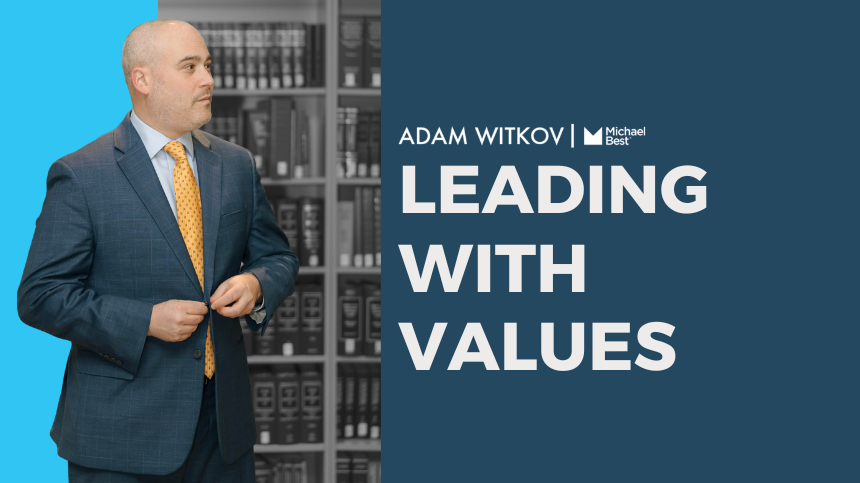
By Adam Witkov, Business Attorney & Litigator | Michael Best
I've been a business attorney long enough to see a clear pattern: the companies that thrive over the long term aren't just the ones with the best products or the deepest pockets. They're the ones led by people who know what they stand for—and who've built that clarity into the very structure of their business.
Values-driven leadership isn't soft. It's strategic. And when your legal infrastructure aligns with your principles, you're not just running a business—you're building something that can last for generations.
Why Values-Driven Business Decisions Create Competitive Advantage
When owners make decisions rooted in their core values, they make better decisions. They're more consistent. They're easier to explain to employees, customers, and partners. And they tend to hold up better when things get difficult.
Think about it this way. When a manufacturing client faces a choice between a cheaper overseas supplier and a more expensive local one, what drives that decision? If they've never articulated their values around community investment or quality control, they'll agonize over spreadsheets. But if they've built their company around a commitment to Wisconsin jobs and supply chain transparency, the decision practically makes itself.
That clarity creates real competitive advantages. Your employees know what to expect and what's expected of them. Your customers understand what you stand for. Your vendors and partners know how you operate. And when disputes arise—and they will—you have a framework for resolving them that's consistent and defensible.
I've watched companies struggle through partnership disputes and shareholder conflicts that dragged on for years, largely because nobody had ever clearly defined what the business was supposed to be about. I've also seen companies navigate major challenges quickly and cleanly because everyone already understood the principles guiding the decision.
Values aren't just nice words on a website. They're the foundation of strategic business counsel that actually works.
Legal Frameworks That Support Company Values
Most business owners don't think about their legal infrastructure as a reflection of their values. But every contract you sign, every policy you implement, and every partnership you enter either reinforces what you stand for—or undermines it.
Employment policies are often the most visible expression of your values. How you handle hiring, compensation, workplace flexibility, and termination tells your people everything they need to know about what kind of company you're building. If you say you value work-life balance but your employment agreements make no accommodation for it, your employees will notice the disconnect.
Vendor selection and supply chain contracts present constant opportunities to align your operations with your principles. Many Wisconsin manufacturers I work with have strong feelings about domestic sourcing, fair labor practices, or environmental sustainability. But unless those values are reflected in your vendor agreements—with clear standards, audit rights, and consequences for violations—they're just aspirations.
Community partnerships and charitable giving can be structured to create real accountability and strategic alignment. Create giving programs that tie directly to your business’s mission, create partnerships that strengthen both your company and community in measurable ways.
The key is intentionality. When you're working with a business attorney that understands your goals, you can build these values into your legal framework from the start—rather than trying to retrofit them after problems emerge.
How to Audit Your Business for Values-Alignment
If you suspect there's a gap between what your company says it stands for and how it actually operates, you're probably right. Most businesses have some degree of misalignment—not because anyone's being dishonest, but because values evolve and legal infrastructure tends to lag behind.
Here's a practical approach to conducting your own values audit:
Start by articulating your actual values. Not the ones on your website—the ones that actually guide decisions. What do you refuse to compromise on? What would cause you to walk away from a deal? What makes you proud about how you do business? Write these down, even if they seem obvious.
Review your employment practices against those values. Do your hiring criteria reflect what you say matters? Do your compensation structures reward the behaviors you want to encourage? Does your handbook address situations in ways consistent with your principles? Are your disciplinary and termination processes fair and transparent?
Examine your key contracts. Pull out your vendor agreements, customer contracts, and partnership documents. Read them not as legal documents, but as expressions of what your business prioritizes. If a stranger read these contracts, what would they conclude about your values?
Look at your community relationships. How do you engage with your local community? Are your charitable activities strategic and aligned with your mission, or scattered and reactive? Do your partnerships create mutual value?
Identify the gaps. Where is there daylight between what you believe and how your business operates? Make a list. Prioritize the gaps that create the most risk or represent the largest misalignment.
This kind of audit isn't something you do once and forget. Values-driven business in Wisconsin—or anywhere—requires ongoing attention. The companies that do this well build regular reviews into their strategic planning process.
Employment Policies That Reflect Company Culture
Employment policies deserve special attention because they touch every person in your organization and send constant signals about what you actually value.
I've seen too many businesses adopt boilerplate handbooks that don't reflect anything distinctive about their culture. The result is that employees experience a disconnect between the company they thought they joined and the rules they're expected to follow.
Consider what your policies communicate about these areas:
Flexibility and work-life integration. Do your policies acknowledge that employees have lives outside work? Or do they implicitly assume that work always comes first? If you value family, how does that show up in your leave policies, scheduling practices, and expectations around availability?
Development and growth. Do you invest in your people's development? Are there clear pathways for advancement? Do your policies support employees who want to build skills and take on new challenges?
Fairness and consistency. How do you handle performance issues? Are expectations clear and consistently applied? When problems arise, do employees trust that they'll be treated fairly?
Voice and participation. Do employees have meaningful input into decisions that affect them? Are there channels for raising concerns without fear of retaliation?
The best employment policies I've helped develop aren't just legally compliant—they're distinctive expressions of what makes a company a good place to work. They attract the right people and help retain them over time.
Building Something That Lasts
Here's what I've come to believe after decades of working with Wisconsin businesses: the companies that create lasting value are the ones led by people who've thought carefully about what they're building and why.
Legal infrastructure is a tool. It can be used to simply minimize risk and enforce transactions. But it can also be used to embed your values into the very structure of your business—creating frameworks that guide decisions, align incentives, and build trust with everyone who interacts with your company.
When your employment policies reflect your culture, your contracts embody your principles, and your community relationships express your mission, you're not just running a business. You're building something that can outlast you.
That's the kind of strategic business counsel I believe in. Not just helping clients solve legal problems, but helping them build businesses that reflect who they are and what they stand for.
/Passle/5f6edd8e8cb62a0bec3e5fd2/SearchServiceImages/2025-09-11-17-02-51-670-68c300bb2b4d83f984228268.jpg)
/Passle/5f6edd8e8cb62a0bec3e5fd2/SearchServiceImages/2026-01-27-13-59-53-664-6978c4d9ad3984136cda8c3d.jpg)
/Passle/5f6edd8e8cb62a0bec3e5fd2/SearchServiceImages/2026-01-27-19-46-47-710-69791627ad3984136cdc8ede.jpg)
/Passle/5f6edd8e8cb62a0bec3e5fd2/SearchServiceImages/2026-01-25-15-27-32-034-69763664c26ba4a239be5b19.jpg)